
About Botswana
Botswana is one of Africa’s great wilderness destinations — a country defined by vast open spaces, thriving wildlife populations, and a conservation model that prioritizes low-impact, high-quality tourism.
Located in Southern Africa and bordered by Namibia, Zambia, Zimbabwe, and South Africa, Botswana is largely flat, semi-arid, and sparsely populated. With just over 2 million people in a country roughly the size of France, it offers visitors an extraordinary sense of remoteness and authenticity.
The majority of Botswana’s population belongs to Tswana ethnic groups, and Setswana is widely spoken alongside English. Cattle farming plays an important role in the economy and cultural identity. Traditional villages, music, and crafts remain part of daily life, especially outside urban areas.
Botswana’s conservation success is closely linked to its political stability. By focusing on sustainable tourism rather than mass tourism, the country has protected its ecosystems while generating revenue to support local communities.
A Brief History
Before colonial rule, Botswana was home to Tswana-speaking kingdoms that were organized, cattle-based societies with strong leadership structures. In 1885, the region became the British Protectorate of Bechuanaland, largely to prevent expansion by neighbouring colonial powers. Unlike many African nations, Botswana experienced minimal settler colonization and gained independence peacefully in 1966.
At independence, Botswana was one of the poorest countries in the world. The discovery of diamonds soon after transformed its economy. Today, Botswana is one of Africa’s most stable democracies, with prudent economic management and a strong commitment to wildlife conservation.
Much of the country is protected as national parks or wildlife reserves.


The Okavango Delta
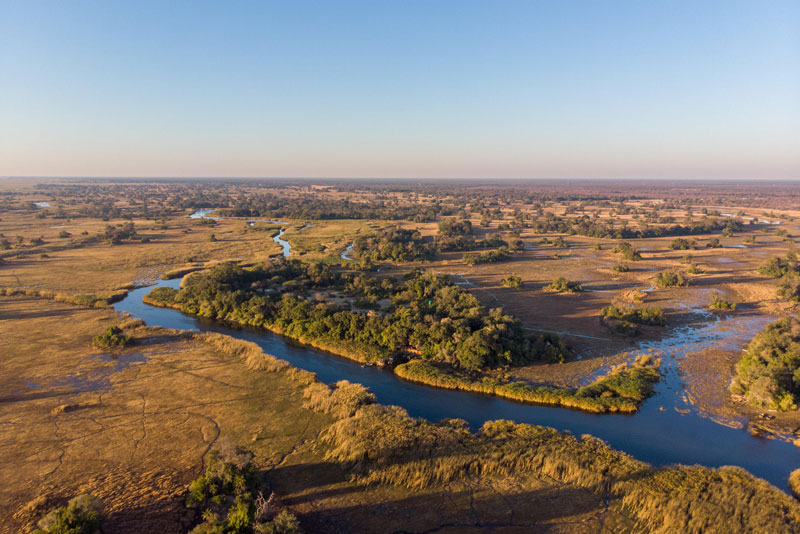
The jewel of Botswana is the Okavango Delta, one of the world’s largest inland deltas and a UNESCO World Heritage Site.
Unlike most river systems, the Okavango River never reaches the sea. Instead, it fans out into the Kalahari Desert, creating a lush oasis of channels, lagoons, and islands.
Seasonal flooding from Angola (typically May to September) transforms the Delta into a watery wilderness teeming with life. Visitors explore by mokoro (traditional dugout canoe), motorboat, or on guided walking safaris. The experience is intimate and immersive — gliding silently past reeds while elephants feed nearby or watching red lechwe antilopes splash through shallow waters.
The Delta hosts remarkable wildlife diversity: lions, leopards, cheetahs, wild dogs, buffalo, hippos, crocodiles, and abundant birdlife. Because Botswana limits visitor numbers and emphasizes small, exclusive camps, safaris here feel uncrowded and personal.
Moremi Game Reserve
Located within the Okavango Delta, Moremi Game Reserve protects some of the Delta’s most wildlife-rich areas. It combines floodplains, forests, and dry savannah, making it one of the most diverse safari destinations in Africa.


Chobe National Park
In the north of Botswana lies Chobe National Park, famous for its enormous elephant herds — among the largest concentrations in Africa. During the dry season, thousands of elephants gather along the Chobe River.
Boat safaris are a highlight here, offering a different perspective from traditional game drives. From the water, visitors can observe elephants swimming between islands, hippos wallowing, and crocodiles basking on riverbanks. Chobe is also rich in birdlife and predators.
The Central Kalahari Game Reserve
Covering a vast expanse in central Botswana, the Central Kalahari Game Reserve is one of the largest protected areas in the world.
This semi-arid landscape of golden grasslands and fossil river valleys feels remote and untouched.
Wildlife here is specially adapted to desert conditions. Visitors may see oryx (gemsbok), springbok, brown hyenas, cheetahs, and black-maned Kalahari lions. The scenery is stark but beautiful, particularly after seasonal rains when the plains turn green and attract migrating herbivores.
The Central Kalahari is also historically home to the San (Bushmen), one of the world’s oldest continuous cultures. Guided experiences offer insights into traditional tracking skills and survival knowledge.

Botswana is best known for high-end safari experiences.
The dry season (May to October) is ideal for wildlife viewing, as animals concentrate around water sources and vegetation is less dense.
An itinerary often combines the Okavango Delta, Moremi, and Chobe, with possible extensions to the Makgadikgadi Pans or the Central Kalahari. Travel between camps is frequently by light aircraft, offering spectacular aerial views of the landscape.
What sets Botswana apart is its sense of exclusivity and raw wilderness. You may spend hours on safari without encountering another vehicle, watching a lion pride at sunset or drifting silently through Delta channels.
Botswana offers not only remarkable wildlife encounters but also the rare feeling of being alone in one of the last great wild places on Earth.
Tailor-made tours and safaris to Botswana
We plan and book your dream holiday based on your budget and individual needs and wishes.
Botswana Highlights:
Kalahari Desert
Okavango Delta
Wildlife safaris
Chobe National Park
Suggested Itineraries:
Botswana: Desert & Delta Safaris
Botswana: Ker & Downey Safaris
Botswana: Wilderness Safaris
Contact us
Would you like to find out more? We can help you book your accommodation, find the right tour - and make all the arrangements for you.